The money is already yours. It just is not visible.
A solution provider carries a dozen vendor relationships, each with its own portal, its own fiscal calendar, its own tier ladder and its own registration rules. Commercial data lives in the CRM. Consumption data lives in the vendor portals. Nothing reconciles them, so the gaps only surface after they have cost something.
- A renewal closes in the first week of the vendor's quarter instead of the last week of the previous one, and a ten to fifteen point pull-forward discount goes unclaimed.
- Won business never gets a renewal opportunity created, so it leaves the forecast entirely and returns as a surprise.
- A registration expires and protected pricing goes with it.
- A rebate or tier threshold is missed by a few points because nobody was tracking against it while the quarter was still open.
- Over-consumption sits in a vendor portal for two quarters before anyone opens it.
- The same SKU is quoted to the same customer at a different price by three different sellers.
10+ vendor portals, each with its own login.
4 vendor fiscal calendars in a typical quarter, none aligned to yours.
1 system that reconciles them today: the spreadsheet.
Why the tools you have do not close this
You almost certainly have a BI tool. It answers the questions you already know to ask, over data somebody already loaded, in a report somebody already built. It does not know what a deal registration is, what a vendor's fiscal year-end does to a discount, or what the next tier rung is worth. Channel economics are not a charting problem. They are a reconciliation problem with a clock attached.
Consumption Intelligence
Consumption Intelligence is the method behind the platform. Take the commercial and telemetry data a solution provider already holds, reconcile it against vendor programs and fiscal calendars, and return a specific next action with a dollar value attached.
Read-only by design. The platform reads from your CRM. It does not write, update or delete records. Where it identifies an action, such as a missing renewal opportunity, a pull-forward window or an expiring registration, it proposes that action for one of your operators to review and apply. Your CRM remains your single source of truth.
Recovered margin on renewals you were already going to close funds the engagement, and the found value is tracked and reported from day one, so the renewal decision rests on documented outcomes.
Five capabilities, one module
Each maps to a distinct data source and a distinct dollar outcome.
Renewal Intelligence
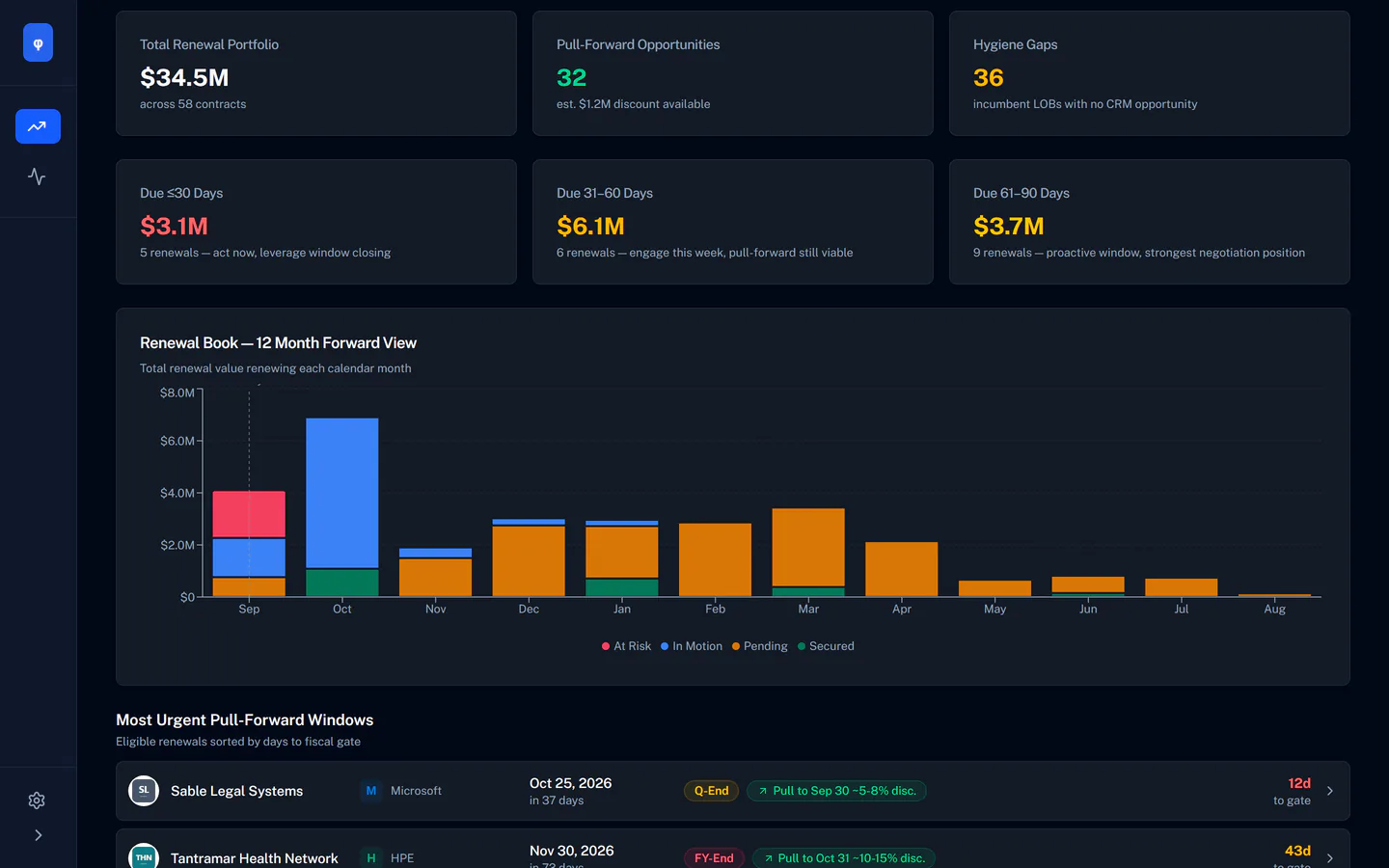
Renewal visibility across your named vendor set by date, value and account. Forecast-gap detection against the CRM. Fiscal-calendar matching and pull-forward window identification. At-risk detection for renewals approaching with no opportunity on file. Data hygiene reporting and connection diagnostics.
Pull-forward eligibility and the estimated discount range are shown against the specific renewal, on the vendor's real fiscal day, so the decision is about one deal rather than a policy.
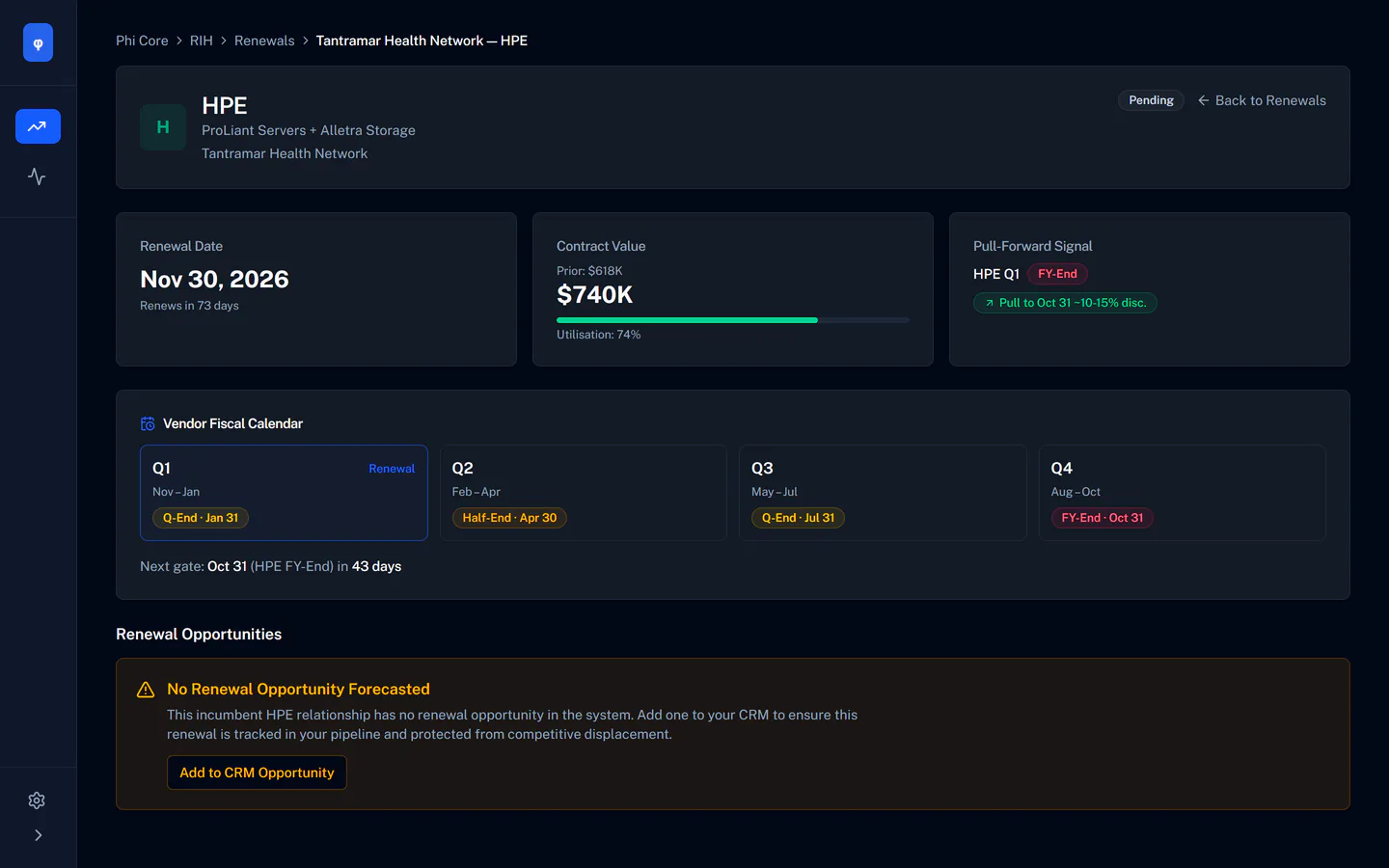
One renewal against the vendor's fiscal quarters, with the pull-forward signal. 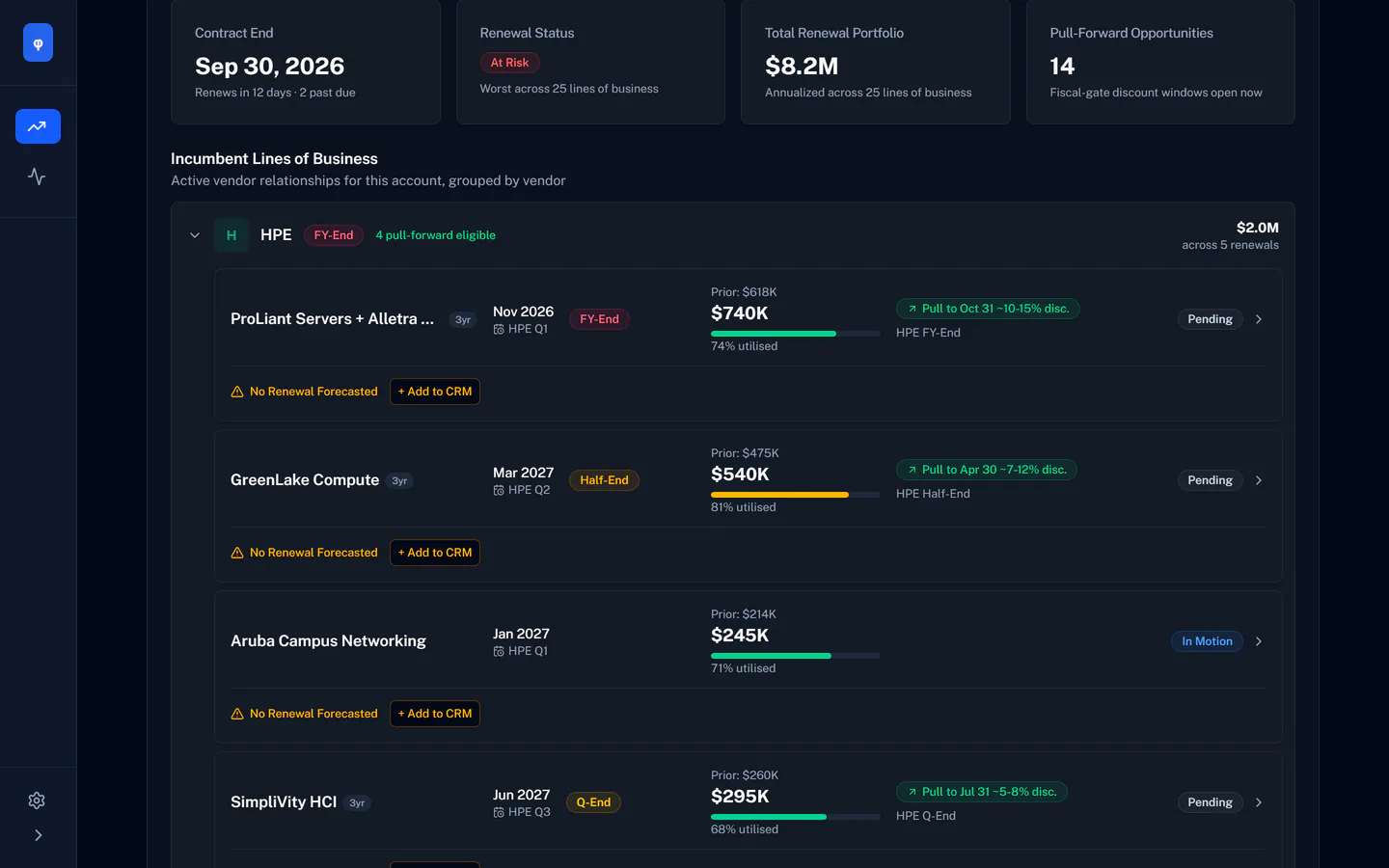
Renewals by vendor group, with fiscal gates and pull-forward discount ranges. Consumption Intelligence
Entitlement versus actual usage for the telemetry vendor subset. Over- and under-consumption flags. Trend and threshold alerting ahead of a breach.
Expansion conversations start from evidence rather than instinct, and under-consumption is treated as a signal, not a failure. It is the earliest warning a renewal is at risk.
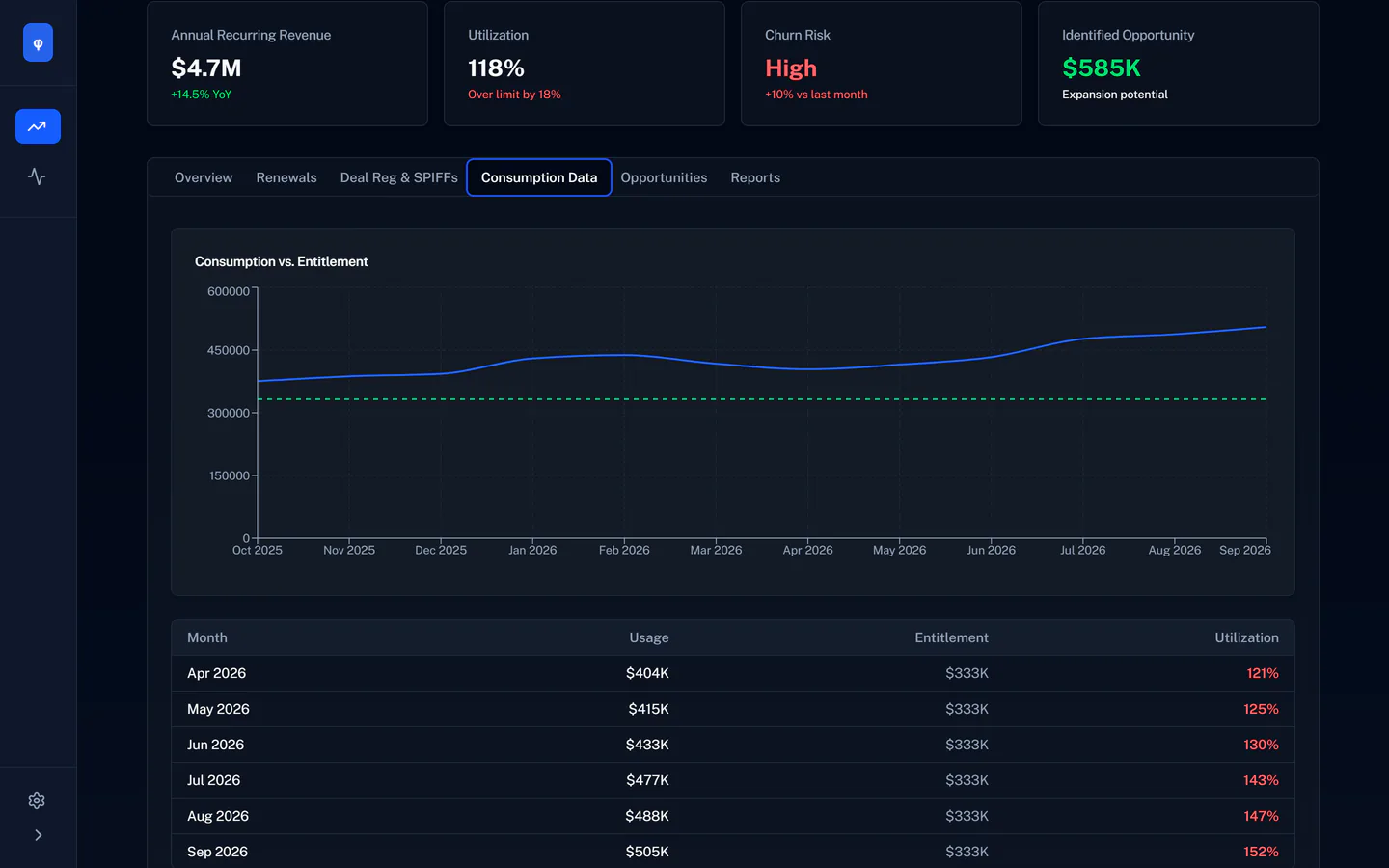
Entitlement against actual usage, with the over-consumption flag. Deal Registration Intelligence
Registration status and expiry windows. Protected pricing. Deal-tied SPIFFs and special pricing deadlines.
Registration intelligence reads from one registration source, selected with you at kickoff: CRM records, a monitored group mailbox, a ticketing system export, or scheduled manual upload. Most solution providers do not hold registrations in the CRM. That is expected, and it is not a blocker.
Eligibility is shown as a compound check across partner status, certifications, timing and record completeness, with the dollar exposure attached to whichever one is failing.
- Veeam90 days from submission, published February 2021, EMEA
- Dell90 days, extendable to 270, published February 2025
- VMware by Broadcom180 days, published December 2024
- LenovoSix months, one 30-day extension, published 2024
Days from approval until a deal registration expires, as each vendor published them on the date shown. The lighter bar is the published extension ceiling. These terms change, and knowing when is the work. 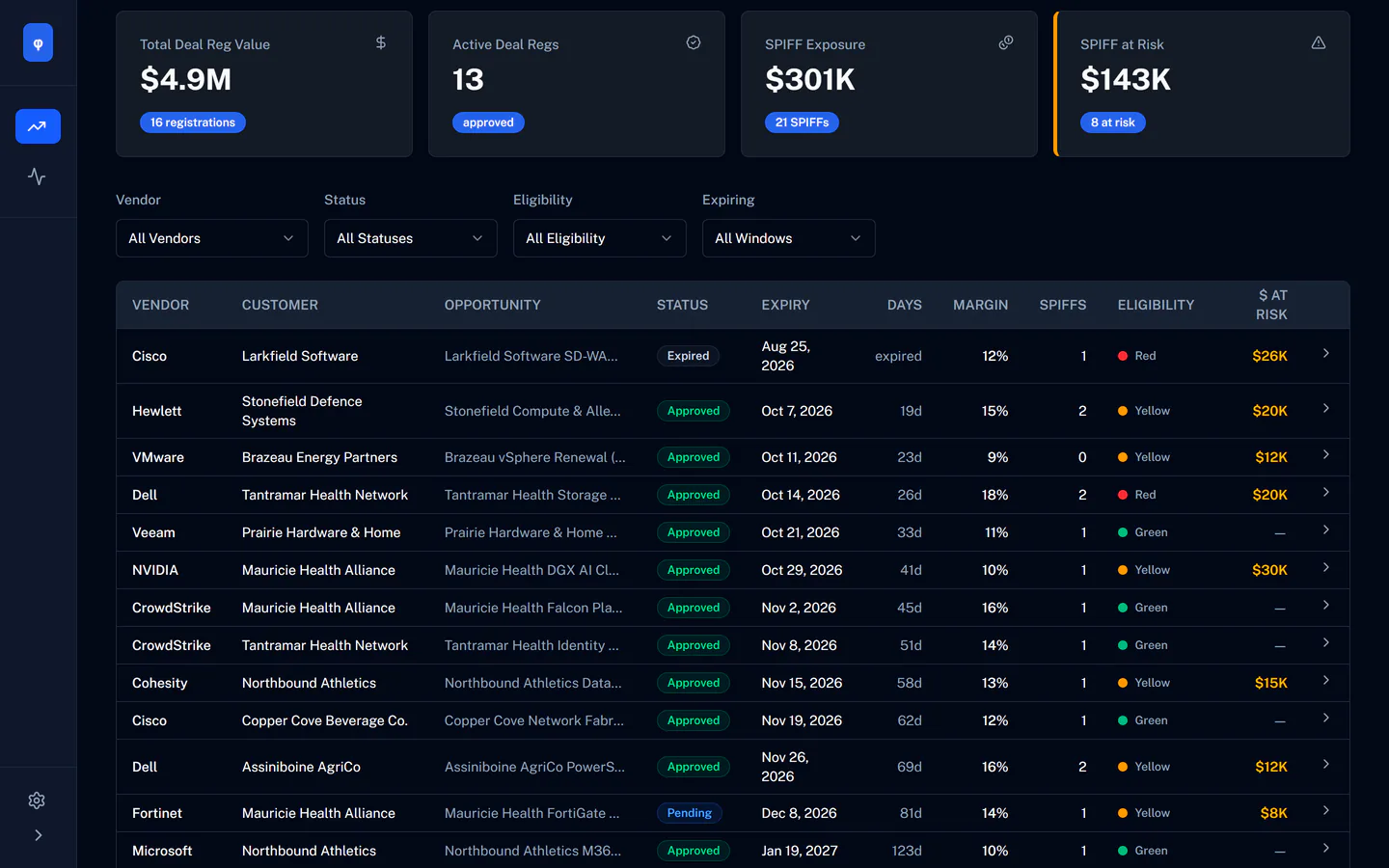
Deal registrations: the eligibility check and the dollar exposure on each. Vendor Program Intelligence
Partner status and tier progression. Certification tracking. Backend rebate and MDF eligibility against your named vendor set.
The full program ladder rung by rung, with the gap to the next rung and what that rung is worth, plus your channel contacts at each vendor in one place.
- CiscoCisco 360 designations, from January 2026, published August 2026
- Partner
- Portfolio Partner
- Preferred Partner
- CohesityAspire Partner Program, published August 2025
- Associate
- Preferred
- Premier
- Check PointPureAdvantage Partner Program, checked September 2026
- Bronze
- Silver
- Gold
- Platinum
- Palo Alto NetworksNextWave Partner Program, published March 2026
- Registered
- Innovator
- Platinum
- Diamond
- VeeamProPartner Network, value-added resellers, checked September 2026
- Registered
- Silver
- Gold
- Platinum
- VMware by BroadcomAdvantage Partner Program, published December 2024
- Registered
- Select
- Premier
- Pinnacle
Partner program tiers from the entry rung to the top, as each vendor published them on the date shown. Where you sit on each ladder and what the next rung is worth is the work. 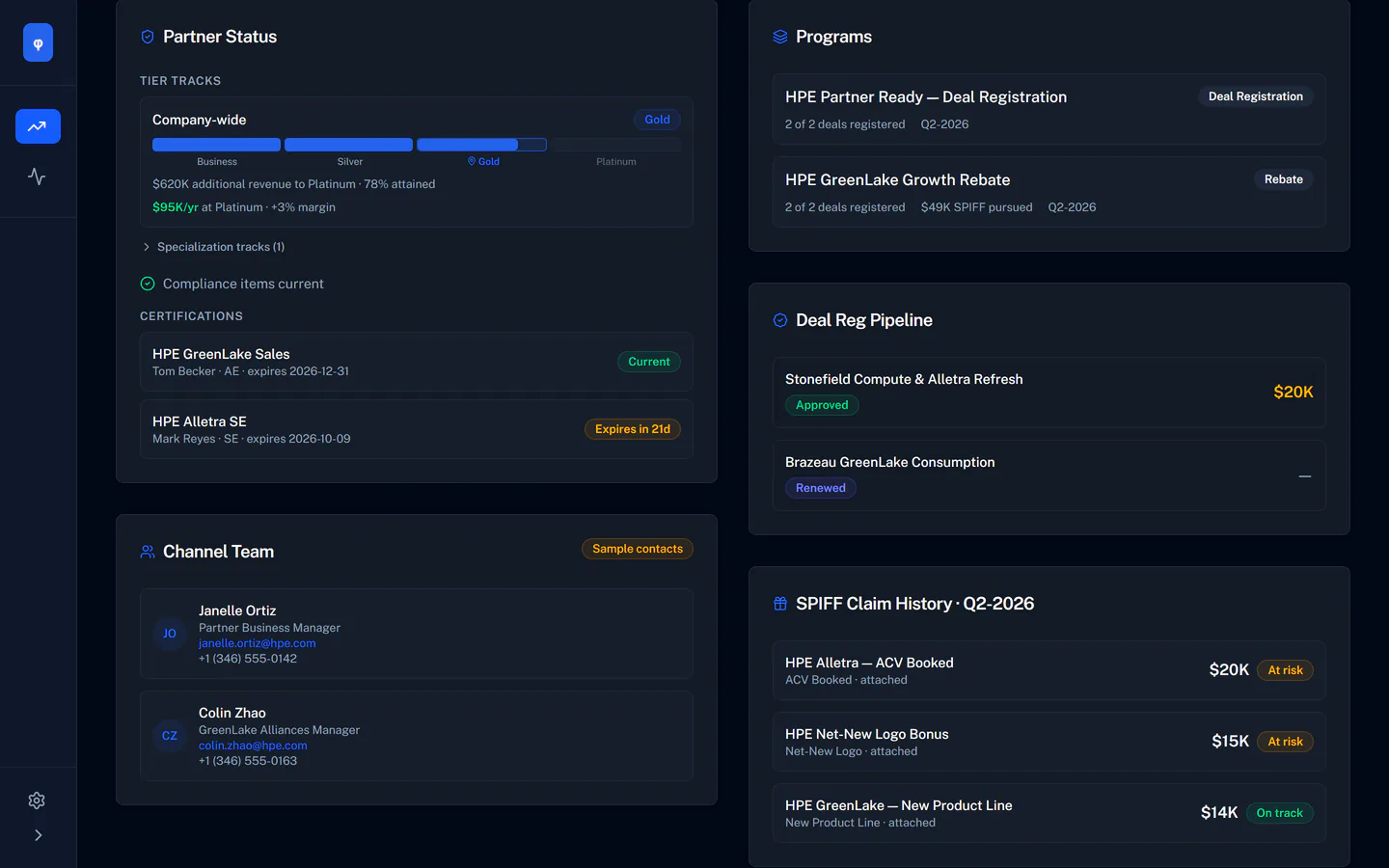
The vendor's tier ladder: current rung, gap to the next and what it is worth. Portfolio Reporting
Weekly renewal artifact. Monthly portfolio review. Reseller-branded outputs you can put in front of your own customers under your own logo.
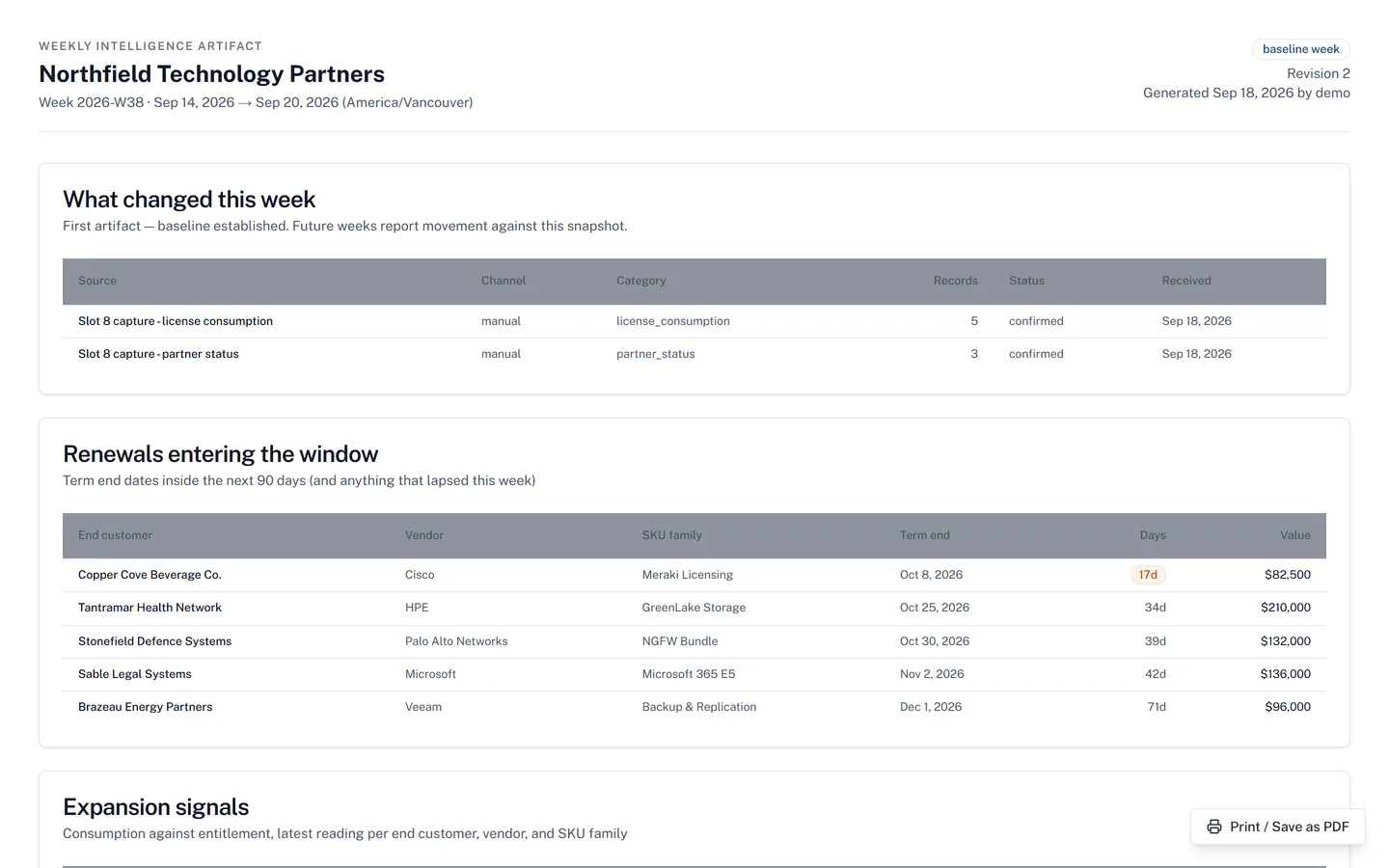
The weekly renewal artifact, under your own logo.
What we can do depends on what each vendor exposes
- Level 1. Renewal, registration and program intelligence, from your CRM records plus the vendor fiscal calendars and channel program data we maintain.Across every named vendor.
- Level 2. Consumption telemetry, which requires the vendor to expose a partner-accessible API and you to hold active partner credentials for it.Across the subset where your book concentration and API availability overlap.
Level 1 runs on data you already hold. Level 2 depends on each vendor's own partner program, not on our willingness. We maintain the fiscal calendars and the program data so you do not have to.
This is the part most tools will not tell you until after you have signed.
Your data works in both directions
Every other tool in this category points one way: inward, at your pipeline. The same intelligence that organises your renewal book is also the strongest position you have ever walked into a vendor meeting with.
- MDF requests backed by your own consumption evidence rather than a narrative.
- Tier and rebate negotiations where you arrive with the numbers already reconciled.
- Quarterly business reviews generated from your data, not assembled the night before.
- Certification and competency gaps costed, so the investment decision is arithmetic.
Most solution providers know their vendor relationships better than the vendor's own channel team does. Very few can prove it in a meeting.
This is the part that compounds. The renewal book pays for the platform in year one. The vendor leverage is what makes it worth more in year three than it was in year one.
Four steps, then it runs
Connect
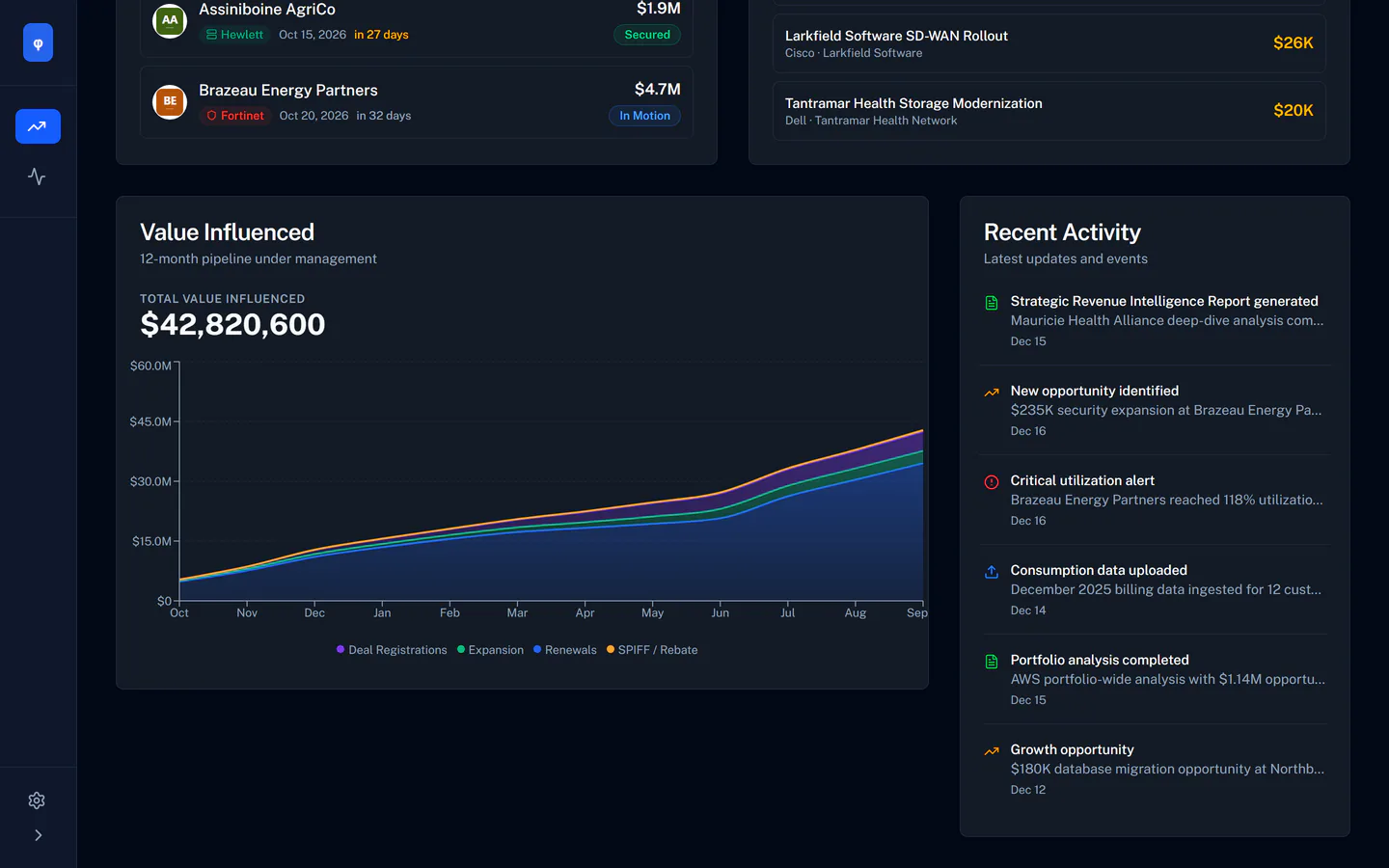
Read-only credential to your CRM, inquire access only. No write, create, update or delete permission is held on any system of yours. Connection state, record counts and data hygiene gaps are reported back to you in a diagnostic console before anything else happens.
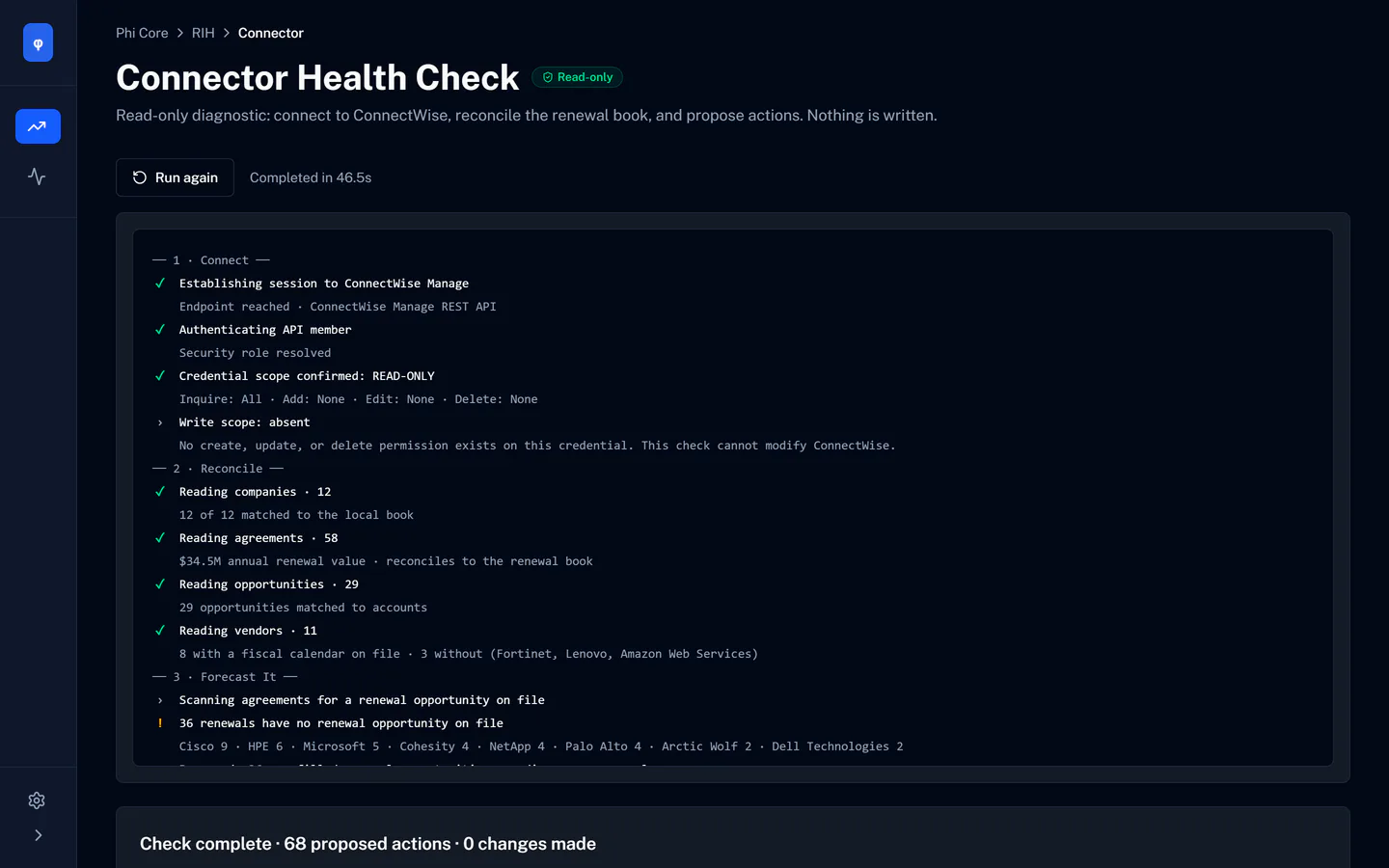
The connector console: connection state, record counts, read-only confirmation. Reconcile
Vendor fiscal calendars, program tiers and telemetry are matched against your commercial records. Where a record is incomplete, a missing term date or an absent renewal opportunity, the platform surfaces the gap rather than inferring a value.
Act
Proposed renewals, pull-forward windows and threshold alerts arrive as actions an operator approves or dismisses.
Report
Weekly artifact, monthly review, found value tracked in dollars from day one.
We carry 85 to 90 per cent of the implementation. Your side is credentials and a service account, one technical contact for the connection, and availability for kickoff and the monthly review. Your team's time is the scarcest thing in this engagement and it is priced that way.
Canadian data residency from day one
- Dedicated tenant per customer. Not a shared environment.
- Residency declared at provisioning, per tenant, based on what your own obligations require, and confirmed in writing before go-live. Cloud-first, not tied to a single provider or region.
- Read-only credential scope. No write, create, update or delete permission on any customer system.
- Confidentiality, intellectual property and deletion governed by the Master Services Agreement, executed before go-live.
- Deployment into a customer-owned cloud tenant available as a separate engagement, so your end-customer pricing data never leaves infrastructure you control.
Deliberately out of scope
- Not a CRM replacement. It reads, it does not own.
- Not write-back automation. Nothing changes in your systems without an operator approving it.
- Not a generic revenue dashboard. It knows what a deal registration is, what a fiscal calendar does to a discount, and what a tier rung is worth.
See it against your own vendor set
A walkthrough runs on a live environment with a representative portfolio. Bring your three largest vendor relationships and we will show you what the platform surfaces against them.